Sunday, June 14, 2020

Eracism Minute 6/14/2020 Lauralee Carbone


Prayer of the day

We honor the revolutionaries and martyrs who have gone before us — all those who struggled for the sake of this new world. We praise you, and the God who formed and led you. In gratitude, we stand on your sacrifices and victories. We invite your presence into our lives, asking for your wisdom, strength, and accompaniment as we join your struggle. Be with us as we continue contending for God’s kin-dom. Amen.

- Friendly Fire Collective

Tuesday, June 9, 2020

Meeting Minutes 6/8/2020


Black Lives Matter Ministry Action Team
June 8, 2020


The program meeting convened at 7 pm on Zoom. The zoom invitation gave the meeting time as 6:30, so some people signed on early. Cat will communicate with BUF Administrator to make sure the time is correct (6 pm for business meeting the first Monday, 7 pm for program meeting on second Monday. Also, publish the link in the midweek update.

Present were Barbara Gilday, Kathryn Allen, Judy Kasper, Paul Beckel, David Curley, Henry Ohana, Rick and Nancy Steele, Michael Betz, Amoret Heise, Jane Ronca-Washburn, Mary Alden, Lauralee Carbone, Claire Lending, Murray Bennett, Genia Allen, Jane DeBrock and Cat McIntyre

First we had check in to introduce ourselves to new people, each describing how they're feeling and what they've been up to. Then we went around with each telling what anti-racism action they expect to be accomplishing immediately. 

1.    Put the Black Lives Matter banner up outside BUF.

2.    Read the list of black-owned businesses in the Bellingham Herald, and patronize those businesses. Also, be aware of businesses that are funding Law & Oder President and cut off spending there (Home Depot, McDonalds, etc.)

3.    Write letters to Whatcom County Executive, Satpal Sidhu to reallocate funding for police and sheriff for community, especially Generations Forward Family Council (see below, at end of minutes).

4.    Create a phone/text tree to notify those interested in actions like the rally on 6/6/20. Henry Ohana and Genia Allen will work on this. Cat will transmit the names to them. We also need a script for such phone calls, with information solicited from those who are contacted by black-led groups for action; this will make sure we have their direction for what is needed and when.  We have current connections to the Whatcom Human Rights Task Force (DavidCurley), Black Lives Matter-Bellingham (Cat) and Racial Justice Coalition (Cat and others).

5.    Educate ourselves about racism and antiracist history and current actions. Read books, watch films, listen to black leaders. Consider organizing resources and posting them in easily-accessed spots on BUF website, and/or BUF Black Lives Matter blog.

David Curley offered a powerpoint describing the Rapid Response Team plan developed in 2019 by the three Beloved Conversations study groups. He offered  to share the powerpoint upon request : dcurley1945@gmail.com We discussed a need for training in what to do and what not to do when demonstrating. 
One suggestion was to practice one-on-one how to de-escalate confrontations with those who are doing racist actions. We suggested using local experts (Training could be arranged with Whatcom Peace and Justice or Whatcom Dispute Resolution Center. Rev. Paul can split the zoom meeting into breakout rooms so we can practice confrontations one on one.

Our next business meeting will be Monday, July 6 at 6 pm. Our next program meeting will be Monday, July 13 at 7 pm.   If we can arrange training with one of the local experts, will conduct that at the July 13 meeting; if not, we will watch the documentary, The Bail Trap. Announcements and zoom links will appear in the BUF Midweek Update and sent out by email to those participating in this meeting,.


Respectfully submitted
Cat McIntyre, co-facilitator


Information about Generations Forward Family Council reported by Mary Alden at 6/8/20 BUF Black Lives Matter program meeting.For further information, contact Hilde Festerling. land line 360 312-0396 or  cll 360 594-8612. Her email is in the email copied below.

Begin forwarded message:

From:Hilde Festerling <hildebootstrap@gmail.com>
Date:June 8, 2020 at 6:35:26 PM PDT
To:Mary Alden <mary@sunrisechapel.org>

Hello to my friends at Black Lives matter BUF!

I have been working with a group called the Generations Forward Family council for the last 18 months. We have helped draft and pass in principle through County Council a plan called the Whatcom County Child and Family Action Plan. This plan was developed with grassroots community oversight and with input from the visionary work of black community leaders. The plan is a blueprint for stopping root causes of childhood trauma and closing equity gaps based on race in the county The county council are writing their budget this month and we are asking community groups for their support and collaboration in asking County Executive Sidhu to Fund the Plan, Not the Police. I've included some of our draft materials, and we welcome your collaboration!

Sample letter to County Executive Sidhu

County Executive Sidhu

We call on you to invest in families and communities, not policing and jails.
This Whatcom County Sheriff’s office has overseen rising incarceration rates and rising jail-time stays. It disproportionately targets, arrests, and incarcerates black, Native American, and Latinx people. These practices are traumatic and destructive to individuals, families and communities, and perpetuate systemic racism and inequity in our county.

The county must stop investing in practices which harm the community and perpetuate systemic injustice. We must invest instead in families, communities, and measures to close equity gaps in our county. The Whatcom County Child & Family Action Plan, which was passed in February of 2004, calls for those investments. While the Child & Family Action Plan offers a clear path forward to support Whatcom children and families, it has not yet received financial backing.

This moment, in which our local crises of poverty, racism, and homelessness are compounded by a pandemic, in which we are all reeling from images of police violence, and in which we are experiencing a national uprising against police brutality, this is the moment to make clear and appropriate financial commitments. The answer is clear: redirect funds away from law enforcement and jails, toward community.

Signed

Tuesday, June 2, 2020

Meeting Minutes 6/1/2020


Black Lives Matter Ministry Action Team
June 1, 2020


The meeting convened at 6 pm on Zoom. Present were Amoret Heise, David Curley, Mary Alden, Cat McIntyre, Lauralee Carbone, Margie Williams, Linda Clarke, Carol Dukes, Virginia Hays, Murray Bennett, Claire Lending, Judy Kasper, Henry Ohana,  Lisa Heezen, Tessie Mandeville, Jan Krouskop, Elizabeth Skinner, Marty Villa=Lovoz, and Genia Allen

Agenda:
1.    Check in, especially for new members
2.    Eracism minutes
3.    June 8 program

1.  Check in.  Many people visited  our zoom team meeting for the first time. Some just want to see what we do. All expressed anger, fear and sadness over recent murder of black men, civil discord and wondering what's next. 

2. Eracism minutes.  Lauralee described the origin and purpose of eracism minutes. We aim to educate, and aren't surprised when we get push-back. Our work is not comfortable, but we believe it is necessary if change is going to come to our congregation and our society.

·     June 7             Henry Ohana            
·     June 14          Lauralee Carbone
·     June 21          Elizabeth Skinner      
·     June 28          David Curley
Services are now broadcast via Zoom. Everyone giving an Eracism minute should be sure to contact Rev. Paul by Wednesday before the service to introduce themself, discuss the focus of the service and learn whether they should attend a rehearsal.
2. June 8 program. We discussed videos and resources for effective action to combat white supremacy and structural racism. Cat suggested Robin DiAngelo's work and website (robindiangelo.com); Lauralee put the Antiracist Checklist for Whites onto the chat; Cat will send it out with the invitation to the next program meeting. Henry gave a phone number to connect to various judicial offices to protest. Mary Alden encouraged people to become active in political groups to influence change through the coming election.
We agreed to each do some homework:find one thing that will make a difference that you want to do, and bring it to the program meeting to share.
Next meeting: June 8, 2020, 7 pm

Respectfully submitted
Cat McIntyre, co-facilitato

Sunday, May 31, 2020

ERACISM Minute 5/31/2020 Cat McIntyre


Hello, I'm Cat McIntyre, a member of the BUF Black Lives Matter Ministry Action Team.
I joined the Black Lives Matters Team at BUF three years ago, precisely because of experiences such as those we all have seen playing out recently:
Ahmaud Arbery, shot to death, while running, by vigilantes in Georgia;
Brionna Taylor, shot eight times by police in her Louisville KY home; and
George Floyd, asphyxiated by a police officer kneeling on his neck for over eight minutes in Minneapolis.
Am I shocked by these stories and images? No.
Why?
Because these are familiar tragedies. Black people in America are always in danger from the very system that is supposed to protect us akk. When these injustices result in death, and are caught on film, they make the news because they have shock value. But they are simply extreme cases of the daily mistreatment that black people, especially black men, experience in America.
I am not shocked because I have endeavored, with Black Lives Matter, to listen to black people when they tell their experience, and to learn as much as I can about the deep injustices in my nation.
Cory Booker, a black politician I much admire, says, "If America hasn't broken your heart, you don't love her enough."
I do love America, and my heart has been broken deeply by what I now know about America's structural racism. As Cory Booker says, "It takes great love of country to point out and to act to end institutionalized racism in America...We cannot allow our inability to do everything about the problem of racism to stop us from doing more than we are right now....If we are not changing, nothing will change."
I can not ignor, excuse or deny these familiar tragedies, because ignoring, excusing and denying them will not stop them happening again and again.
All these deaths and the anger they generate across the nation pile on top of our current experience of coronavirus. The disease has revealed, in stark relief. the inequities in our health care system, our economic system, and our criminal justice system
This eracism minute has already gone on more than a minute. But, I believe I am not alone in being broken hearted by what's been going on in our county.
Please join us at our Black Lives Matter zoom meeting tomorrow evening at 6 pm to explore these matters in more depth. I will send you a link to the meeting if you request, and promise we will end before Taizé at 7.


Tuesday, May 26, 2020

ERACISM Minute 5/24/2020 David Curley


I am David Curley, from the BUF Black Lives Matter Ministry Action Team.
This Memorial Day I want to remember my experiences of race in the US Army, in the fateful years 1968-1969.
Early in my Army time, I lived with African American soldiers in Fort Gordon, Georgia. One was my bunk-mate. He was funny, temperamental, and completely irreverent. They all teased me about long—and infrequent—letters from my girlfriend.
These easy memories end abruptly with the assassination of Dr. Martin Luther King on April 4, 1968. Our commanding officer’s response was, “We are all one color. We are all Army green.”
In two weeks we finished training, and almost all of the soldiers that I knew went directly to Vietnam.
In my year in Vietnam, the Army failed to deal with King’s murder, the so called “ghetto riots,” white backlash. and
Soldiers both created and adjusted to a new racial climate: Confederate flags and country music versus James Brown black power salutes that could get you an Article 15 (punishment), bar fights and disproportionate punishments for black soldiers. In that year I had two black friends, but not close friends. One rotated home long before I did. I asked the other one, Daniels, to my going-away steak and beer party. He said, “Nothing personal, but I got other things.” I said, “At least come pick up the steak I’m saving for you,” and he did.
Sargent Hunt, black, middle aged, and on his second tour in Vietnam, was my boss for over half a year. He put me in for a minor medal. The citation, “selfless, dedicated, above and beyond the call of duty, etc.” made no sense. I couldn’t imagine why, and privately asked him. He said, “You went to college. You could have undermined me at any time, and you never did.”
The US Army in Vietnam was systemically a racist institution, but not as racist as “back in the world.” Home. Discrimination against returning black veterans was both more intense and more invisible, and to see this, I hope we can get together to watch Spike Lee’s new movie, “Da Five Bloods,” to be released in June on Netflix.
What would mean the most to me for this Memoraial Day would be a moment of silence for all black veterans.

Wednesday, May 13, 2020

65 Things White People Can Do for Racial Justice

Corinne Shutack
Aug 13, 2017 · 13 min read
  1. Google whether your local police department currently outfits all on-duty police officers with a body-worn camera and requires that the body-worn camera be turned on immediately when officers respond to a police call. If they don’t, write to your city or town government representative and police chief to advocate for it. The racial make-up of your town doesn’t matter — This needs to be standard everywhere. Multiply your voice by soliciting others to advocate as well, writing on social media about it, writing op-eds, etc.
  2. Google whether your city or town currently employs evidence-based police de-escalation trainings. The racial make-up of your town doesn’t matter — This needs to be standard everywhere. Write to your city or town government representative and police chief and advocate for it. Multiply your voice by soliciting others to advocate as well, writing on social media about it, writing op-eds, etc.
  3. More and more stories of black folks encountering racism are being documented and shared through social media — whether it’s at a hotel, with the police, in a coffee shop, at a school, etc. When you see such a post, call the organization, company, or institution involved to tell them how upset you are. Then share the post along with the institution’s contact information, spreading the word about what happened and encouraging others to contact the institution as well. Whether the company initiated the event or failed to protect a POC during an onslaught by a third party, they need to hear from us.
  4. If you or a friend is an educator, buy said friend books that feature POC as protagonists and heroes, no matter the racial make-up of the class. A few good lists are here, here, here, here, here, here, and here. And/or purchase educational toys that feature POC, such as finger puppets, Black History Flashcards, etc for their classroom. Use these items year-round, not just in February. The racial make-up of students doesn’t matter — kids of every race need to know American history and be exposed to people from different races, religions, and countries. If the friend is interested, buy them for your pal’s classroom. Don’t be shy to ask Facebook friends that you haven’t actually talked to in ten years.
  5. If you or a friend or family member is an educator, watch or share this video of Neil deGrasse Tyson speaking about his experience as a black student telling people he wanted to be a scientist and astrophysicist. Tyson’s experience reminds me of a black friend whose high school teachers tried to dissuade her from taking AP classes, because, with the best of intentions, they thought the AP classes would be “too much” for her. Be an educator who supports and encourages, not one who dissuades. Talk to educators you know about being educators who support and encourage, not educators who dissuade.
  6. Work on ensuring that black educators are hired where black children are being taught. If you want to know more about why and how this makes a difference for black children, check out this episode of Malcolm Gladwell’s podcast. There are some really good nuggets in there about how schools can support the achievement of black students — from ensuring black students aren’t closed out of gifted programs by using test results instead of white teachers’ recommendations to the influence that having a black teacher has on a black student’s education to the importance to fostering a school ethos wherein black students think, “This school is here for me.”
  7. Many companies have recruiting channels that are predominantly white. Work with your HR department to recruit Americans who are descendants of slaves. Recruiting from HBCUs is a good start. Work to put descendants of slaves already hired under supportive managers.
  8. Donate to anti-white supremacy work such as your local Black Lives Matter Chapter, the National Council for Incarcerated and Formerly Incarcerated Women, the NAACP, Southern Poverty Law Center, United Negro College Fund, Black Youth Project 100, Color of Change, The Sentencing Project, Families against Mandatory Minimums, A New Way of Life, and Dream Defenders. Join some of these list-serves and take action as their emails dictate.
  9. Support black businesses. Find them on WeBuyBlack, The Black Wallet, and Official Black Wall Street.
  10. Bank black. It doesn’t have to be all of your checking or savings. Opening up an account with some money is better than no account at all. You can use the link from #9 (type “banking” in the Category field) or this site to find a bank. At the very least, move some or all of your checking, savings, mortgage, etc out of Wells Fargo as a part of the divestment movement to protect Standing Rock.
  11. Don’t buy from companies that use prison labor. Find a good list here.
  12. Read up about mandatory minimum sentences and watch videos about this on Families Against Mandatory Minimums (FAMM’s) website. FAMM’s website includes work being done at the federal level and state level. Call or write to your state legislators and governor about reducing mandatory minimum sentences for non-violent drug crimes.
  13. To reduce mandatory minimum sentences on a federal level, call or write to your federal legislators in support of the bipartisan (sponsored by Sen Lee (R-UT)) Smarter Sentencing Act (S. 2850) which reduces the length of federal mandatory minimum drug sentences by half, makes the Fair Sentencing Act’s crack sentencing reforms retroactive, and expands the “safety valve” exception to mandatory drug sentences.
  14. To reduce mandatory minimum sentences on a federal level, call or write to your federal legislators in support of the bipartisan (sponsored by Sen Rand (R-KY)) Justice Safety Valve Act (S. 399, H.R. 1097), which would allow judges to give sentences other than the mandatory minimum sentence for any federal crime.
  15. To reduce mandatory minimum sentences on a federal level, call or write your federal legislators in support of another great criminal justice reform bill, the Second Look Act, which would make reduced sentences for crack convictions from the previously passed Fair Sentencing Act retroactive, reduce mandatory minimums for people convicted more than three times for drug crimes from life without parole after the third offense to 25 years, reduce mandatory sentences for drug crimes from 15 to 10 years, limit the use of solitary confinement on juvenile prisoners, etc.
  16. Call or write to your state legislators and governor to support state-wide criminal justice reform including reducing mandatory minimum sentences, reducing sentences for non-violent drug crimes, passing “safety valve” law to allow judges to depart below a mandatory minimum sentence under certain conditions, passing alternatives to incarceration, etc. Study after study shows that racism fuels racial disparities in imprisonment, and most of the US prison population are at the state and local level.
  17. Call or write to state legislators, federal legislators, and your governor to decriminalize weed. No, not because black folks use weed more frequently than white folks. Because black Americans are arrested for marijuana possession far more frequently than whites.
  18. Find and join a local “white space” to learn more about and talk out the conscious and unconscious biases us white folks have. If there’s not a group in your area, start one.
  19. Join or start a Daughters of Abraham book club in your Church, mosque, or synagogue.
  20. Join your local Showing up for Racial Justice (SURJ) group. There is a lot of awesome work going on locally — Get involved in the projects that speak to you.
  21. Do deep canvassing about race and racial justice. Many SURJ groups are organizing them, so many people can do it through your local SURJ group. If they’re not already doing it, start it.
  22. Research your local prosecutors. Prosecutors have a lot of power to give fair sentences or Draconian ones. In the past election, a slew of fair-minded prosecutors were elected. We need more.
  23. Call or write to state legislators, federal legislators, and your governor to end solitary confinement in excess of 15 days. It is considered torture by the UN, and it is used more frequently on black and Hispanic prisoners. For more information on solitary, two good overviews can be found here and here.
  24. Watch 13th. Better yet, get a group of friends together and watch 13th.
  25. Watch The House I Live In. Or get a group of friends together and watch it.
  26. Read The New Jim Crow by Michelle Alexander. Better yet, get a group of friends together to read it like a book club would — read, then discuss.
  27. Read Caught by Marie Gottschalk. Better yet, get a group of friends together to read it like a book club would — read, then discuss.
  28. Read Between the World and Me by Ta-Nehisi Coates. Yep, get a group of friends together to read it like a book club would — read, then discuss.
  29. Read Orange is the New Black. The information the author shares about the ease with which one can be charged with “conspiracy” to sell drugs, the damage done from long sentences that don’t fit the crime due to mandatory minimum sentencing, the ever-present threat of solitary confinement at a Correction Officer’s whim, and other specific harmful practices in the prison system are well done. Get a group of friends together to read it like a book club would — read, then discuss.
  30. Read The Color of Law. Get your friends on board reading it, too.
  31. Especially if you or a friend is an educator, read or share bell hooks’ Teaching to Transgress.
  32. Buy books, choose TV shows and movies, and opt for toys for your kids, nieces, nephews, etc that show people from different races, religions, countries and that teach real American history. A few ideas: the books, toys, and flashcards from #4.
  33. Decolonize your bookshelf.
  34. Listen without ego and defensiveness to people of color. Truly listen. Don’t scroll past articles written by people of color — Read them.
  35. Don’t be silent about that racist joke. Silence is support.
  36. Follow @OsopePatrisse, @opalayo, @aliciagarza, @bellhooks, @Luvvie, @mharrisperry, @VanJones68, @ava, @thenewjimcrow, @Lavernecox, @deray, @thedididelgado, @TaNehisiCoats, Ally Henny on Facebook, and Lace on Race on Facebook. Follow them with the intention of listening and learning only. Pay lesser known activists like @thedididelgado here, Ally Henny here, and Lace on Race here for their teaching, time, and work.
  37. Find out how slavery, the Civil War, and the Jim Crow era are being taught in your local school. Is the school teaching about post-Civil War convict leasing, the parent to our current mass incarceration system? Talking about slavery alone, is your school showing images such as Gordon’s scourged back, a slave ship hold, and a slave nurse holding her young master? Are explorers, scientists, politicians, etc who are POC discussed? Are male and female authors who are POC on the reading lists? Are Japanese internment camps being discussed? There are a lot of great resources out there with a little googling, like PBS’s resources for teaching slavery, Teaching for Change, and The National Association for Multicultural Education.
  38. Arrange for cultural exchanges and cultural ambassadors in your local school’s classrooms. The International Classroom program at UPenn and People to People International are options. The Dept of Education has a good list. Cultural exchanges via the interwebs are very valuable. Actual human interaction between people from different races, religions, and countries (ie: cultural ambassadors) and students in the physical classroom is ideal.
  39. Seek out a diverse group of friends for your kids.
  40. Seek out a diverse group of friends for you. Practice real friendship and intimacy by listening when POC talk about their experiences and their perspectives. They’re speaking about their pain.
  41. Watch these videos to hear first hand accounts of what our black brothers and sisters live. Then read everyday people’s experiences through the hashtag #realizediwasblack. Share with others.
  42. Got close friends and/or family who are black? Contribute to their kids’ college savings.
  43. Call or write to your national legislators, state legislators, and governor in favor of affirmative action. Encourage friends to do the same.
  44. Write to your college/university about implementing all or some of these diversity strategies that effectively promote racial, ethnic, and socioeconomic diversity on campus. Write to the public universities your tax payer dollars support about implementing these diversity strategies.
  45. Recognize that in the same way saying “slavery is a necessary evil” (Thomas Jefferson’s words) was acceptable by many in 1820, the same way saying “separate but equal” was acceptable by many in 1940, choosing to not condemn white nationalism, the fact that black people are 2.7 times as likely to be killed by police than white people, the fact that unarmed black Americans are roughly five times as likely as unarmed white Americans to be shot and killed by a police officer, that the fact the black imprisonment rate for drug offenses is about 5.8 times higher than it is for whites, etc are acts of overt racism in 2019.
  46. Write to the US Sentencing Commission (PubAffairs@ussc.gov) and ask them to:
    — reform the career offender guideline to lessen the length of
    sentences
    — change the guidelines so that more people get probation
    — change the criminal history guidelines so that a person’s
    criminal record counts against them less
    — change guidelines to reduce mandatory minimum
    sentences for non-violent crimes
    — conduct a study to review the impact of parental incarceration on minor children. With more data, the Commission could modify the Sentencing Guidelines and allow judges to take this factor into account when sentencing individuals for non-violent crimes.
    — conduct a study to review whether the Bureau of Prisons is following the Commission’s encouragement to file a motion for compassionate release whenever “extraordinary and compelling reasons” exist.
    — consider amending the guidelines to reduce sentences for first offenders.
  47. Read Van Jones’ short and to-the-point article about the racial biases of reporters. More examples are here. Check out this article discussing how media coverage of the opioid epidemic — which largely affects suburban and rural whites — portrays it as an outside threat and focuses on treatment and recovery, while stories of heroin in the 1970s, crack-cocaine in the 1980s, and other drug problems that impact urban people of color today have focused on the drug user’s morality. Keep an eye out for such biases, and use social media and direct communication to the media outlet to call them out when they occur.
  48. Donate to groups that are working to put women of color into elected office, to get out the vote, and to restore voting rights to disenfranchised voters.
  49. Know our American history. Watch Roots, 12 Years a Slave, Mississippi Burning, and Selma, to name a few.
  50. Check out black movies, TV, and other media that show POC as lead characters and in their full humanity. Queen Sugar, Insecure, Dear White People, The Carmichael Show, Blackish, Grownish, Atlanta, 2 Dope Queens, Black Panther, A Wrinkle in Time, Get Out, Girls Trip, Mudbound, How to Get Away with Murder, Scandal, The Cloverfield Paradox, Sorry to Bother You, Blindspotting, BlacKkKlansman, Little, If Beale Street Could Talk, and Queen ans Slim are a few. Share them with friends. In addition, if you can’t watch the whole video, watch 13:12 to 15:17 of this discussion about working in Hollywood when you’re not white.
  51. Know what indigenous land you’re living on by looking that this map and research the groups that occupied that land before you did. Find out what local activism those groups are doing and give your money and time to those efforts.
  52. When people say that Black Lives Matter is a violent/terrorist group, explain to them that there are fringe groups that are being misrepresented as part of BLM. If conservatives don’t want to be lumped in with the KKK, they can’t lump violent protesters in with BLM.
  53. When people ask, “Why aren't you talking about ‘black-on-black crime’?” and other myths about BLM, let Francesca Ramsey help you with those talking points.
  54. Stop shopping at Amazon and Whole Foods. They advertise on -that’s to say fund- white supremacist media.
  55. Be honest about our history. One genocide, another genocide, then apartheid. It sucks, but it’s true. We’ll never be free from our history unless we’re honest about it. Denial is our pathology, but the truth will set us free.
  56. If you have a close relationship with a young person of color, make sure he/she knows how much you love them. Love and affirm that child.
  57. Write to your city or town government representative to replace Columbus Day with Indigenous People’s Day like these cities did.
  58. Donate to Standing Rock through the Standing Rock Sioux Tribe.
  59. Write to your city or town government representative to divest from banks that are financing the DAPL, private prisons, and detention centers. Seattle and Davis, CA already did, as well as Los Angeles, and there are campaigns going on in many cities to divest. Start here: http://howtodivest.org/
  60. Personally divest your investments in private prisons and detention centers. Start here. Many people are divesting from Wells Fargo for their substantial role in Standing Rock and from private prison companies Corrections Corporation of America (CCA), GEO Group, CoreCivic, and G4S.
  61. Get your city/town, company, place or worship, etc to divest from private prisons and detention centers. Since the start of a national prison divestment campaign, cities like New York and Cincinnati, higher ed institutions, churches, and corporations have divested.
  62. Read this article about an overt white supremacist’s son’s journey to relinquish white supremacy and watch this video about Daryl Davis, a black man who gets KKK members to disavow by befriending them. For those you know who are overtly racist (see #45), think about ways you can create exposure for them to people who don’t look like them, share their religion, etc. Jane Elliott says, “People who are racist aren’t stupid, they’re ignorant. And the answer to ignorance is education.” Frederick Douglass notes, “It is easier to build strong children than to repair broken men.” It may be best to focus on children, adolescents, and young adults currently being raised by overtly racist parents. Maybe it’s tutoring them so they could get on a college track, encouraging them to study abroad, or turning them on to colleges where not everyone looks like them and shares their religion, etc. Maybe it’s spending time with them on some regularity and showing them the achievements and beauty of non-white cultures. Be creative.
  63. Talk to the white people you know who aren’t clearly upset by white supremacy. Use “I” statements and “I care” messages (“I feel [feeling] when you [behavior]”). They need to know you see a problem. Call them out, and call them in. As a start, ask them to watch the videos in #40. For people you know who’ve been radicalized by FOX News and other nationalist (not conservative) media, who’ve been so pummeled with fear and hatred of “the other” that they’ve become ISIS-like towards others, how can you and other family and friends guide them through conversation to show them that their actions are now in direct contrast with the values they feign to purport?
  64. As a nod to #63, don’t become the monster, as you try to kill the monster. As Gloria Steinem says, “The ends don’t justify the means. The means are the ends.”
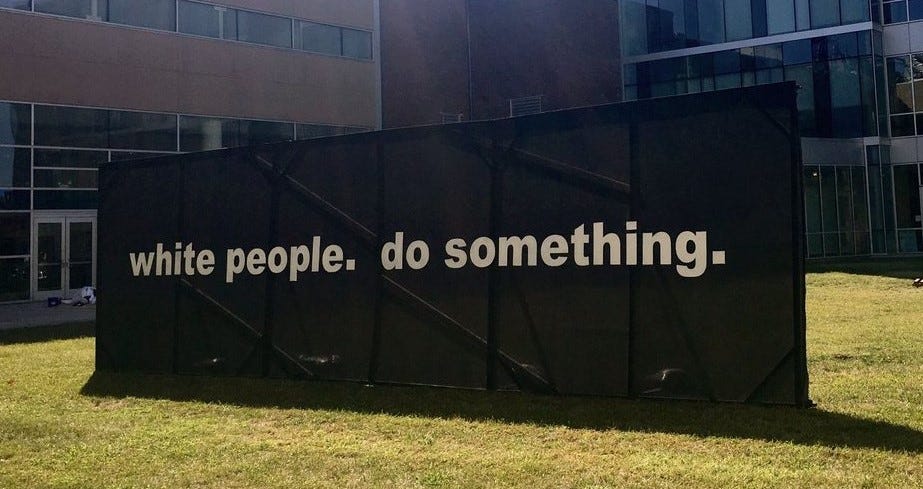
  65. Credit Black men and women. Kara Springer, a black woman artist, created the image/public art that begins this piece. It’s called A Small Matter of Engineering, Part II.  tweeted to ensure the art was attributed appropriately and correctly.

Program Guest Speaker May 15th

On May 15th, our guest speakers were Barbara Miller and Adilene Calderone of Friendship Diversion Services.  This was the second of our prog...